Skin· 4 min read
Sensitive Skin: What It Is and How to Care for It
Skin that stings, flushes or feels tight is usually asking for less, not more. A calm guide to sensitive skin: what is behind it, common triggers and a simple routine.
Words: Íris Laxdal
Photography: Ari Magg

So many of the messages I receive start the same way: "My skin reacts to almost everything." Tightness after cleansing, redness that comes and goes, products that sting the moment they touch the skin. If that sounds familiar, you are far from alone, and you have not done anything wrong.
I started ANGAN in my kitchen because I was searching for products that could calm my own sensitive, reactive skin. This is what I have learned along the way, from formulating, from customers and from living with skin that does not always behave.
What Is Sensitive Skin?
Sensitive skin is not a skin type in the way dry or oily skin is. It describes how skin behaves: it reacts more easily. It might sting, itch, flush, feel tight or turn red when it meets something new, when the weather changes or when you are tired and stressed. Many people with dry, oily or combination skin also feel that their skin is sensitive.
Very often, what sits behind it is a stressed skin barrier. The outermost layer of the skin is a little like a brick wall, with skin cells held together by natural lipids. When that wall is intact, skin holds on to moisture and keeps irritants out. When it is weakened, by harsh cleansing, too many active ingredients, cold wind or dry indoor heat, skin loses moisture more easily and becomes quicker to react.
Sensitive skin rarely needs more. It usually needs less, done gently and consistently.
Common Triggers
- Foaming cleansers that leave skin feeling squeaky clean and tight
- Layering many active ingredients at once, such as acids, retinol and strong vitamin C
- Over-exfoliating, or scrubbing the face too often
- Cold wind, sudden changes in temperature and dry heated rooms in winter
- Very hot showers
- Stress and too little sleep
- Ingredients your skin simply does not tolerate, which is why patch testing matters


How to Care for Sensitive Skin
The good news is that sensitive skin usually responds beautifully to a simple, calm routine. These are the principles I come back to again and again:
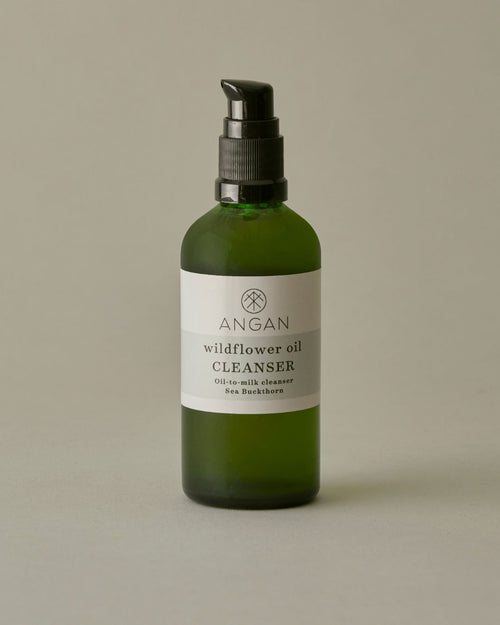
- Cleanse gently. An oil cleanser dissolves makeup and sunscreen without stripping the skin. Our Wildflower Oil Cleanser turns milky with a little water and rinses away, leaving skin soft rather than tight.
- Support the barrier. Skin-friendly oils and a good moisturizer help skin hold on to moisture. A few drops of Arctic Youth Face Oil, pressed into damp skin, is my everyday step.
- Introduce actives slowly. One new product at a time, a few times a week to begin with. Choose gentler forms, such as a stable vitamin C ester instead of pure ascorbic acid, or bakuchiol instead of retinol.
- Protect in the morning. Daily sunscreen is one of the kindest things you can do for reactive skin.
- Keep it short. Three or four steps you do every day will do more than ten steps you do now and then.
Patch Testing, Always
Before using anything new on your face, apply a little to the inside of your arm or behind your ear for a few days. Natural ingredients are not automatically gentle, and essential oils in particular do not suit every skin. If you know your skin reacts to fragrance, look for fragrance-free formulas: our Sun Glow Vitamin-C Serum and Moon Magic Bio-Retinol Serum are both fragrance free.
A Simple Routine for Sensitive Skin
Morning: rinse with lukewarm water or cleanse gently, then a few drops of a soothing serum or face oil on damp skin, a moisturizer and sunscreen.
Evening: cleanse with an oil cleanser, then one treatment step, such as a gentle bakuchiol serum a few nights a week, followed by a face oil or moisturizer.
Give any change at least four to six weeks. Skin renews itself slowly, and calm skin is built over time, not overnight.
When to See a Doctor
If your skin is persistently red, burning, flaking, itchy or bumpy, it may be something more than sensitivity, such as rosacea, eczema or contact dermatitis. A dermatologist or doctor can help you understand what is going on, and skincare can then support the care they recommend.
Above all, be patient and kind to your skin. In my experience, the calmest skin belongs to the people who stopped fighting it.
In this story